
How Much Piping Is Required for a Ground Source Heat Pump? – An In‑Depth Analysis of Ground Loop Design in Flamingo’s Water‑Source & Ground‑Source Heat Pump Systems
As the global dual‑carbon (Carbon Neutrality) strategy deepens and energy structures rapidly transform, Ground Source Heat Pump (GSHP) technology is entering the public spotlight at an unprecedented pace. Using shallow geothermal energy for heating and cooling, GSHP systems are now widely applied in residential buildings, offices, schools, hospitals, hotels, and more.
Yet for many potential users and engineering designers, one core question remains: How much piping is actually required for a ground source heat pump system? This seemingly simple question involves complex interactions among building load calculation, geological survey, unit selection, and system configuration. This article provides a professional answer, leveraging the advanced water‑source & ground‑source heat pump products from Flamingo , and interprets the latest industry trends for 2025‑2026.
1. Core Principle of GSHP and the Importance of the Ground Loop
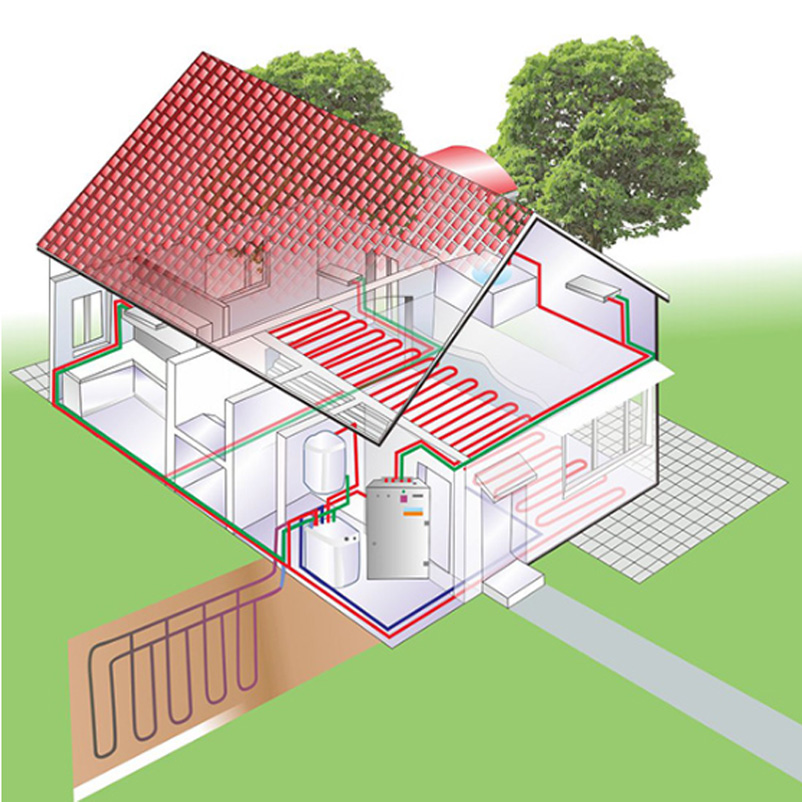
A Water‑Source / Ground‑Source Heat Pump system uses shallow geothermal energy for highly efficient heating and cooling. By consuming a small amount of electricity, it transfers low‑temperature heat to a higher temperature level. In winter it extracts heat from the ground, and in summer it rejects heat into the ground. With a typical Coefficient of Performance (COP) of 4–5, it saves 50–75% energy compared to conventional air conditioning.
The Ground Heat Exchanger (Ground Loop) is the heart of the entire system. Without it, the heat pump cannot exchange energy with the earth. Therefore, accurately calculating the required borehole / trench length is the first and most critical design step.
2. Key Factors Affecting Ground Loop Length
To answer “how much piping”, five major factors must be understood.
2.1 Building Heating & Cooling Load
The larger the building load, the more heat must be exchanged with the ground, and the longer the piping required. The heat rejected to the ground in summer and absorbed in winter can be calculated as:
Summer heat rejection: Q′ = Q₁ × (1 + 1/COP₁)
Winter heat extraction: Q′ = Q₂ × (1 – 1/COP₂)
Where Q₁ = total cooling load (kW), Q₂ = total heating load (kW), COP₁ = cooling COP, COP₂ = heating COP. COP values should be taken from product datasheets under design conditions.
2.2 Geological Conditions & Soil Thermal Properties
Soil thermal conductivity is the most significant factor influencing loop length – research shows an influence index as high as 0.909. Higher thermal conductivity means better heat transfer and shorter required piping. Therefore, every GSHP project must conduct a Thermal Response Test (TRT) to obtain real local thermal properties before detailed loop design.
2.3 Choice of Loop Configuration
Two main configurations exist:
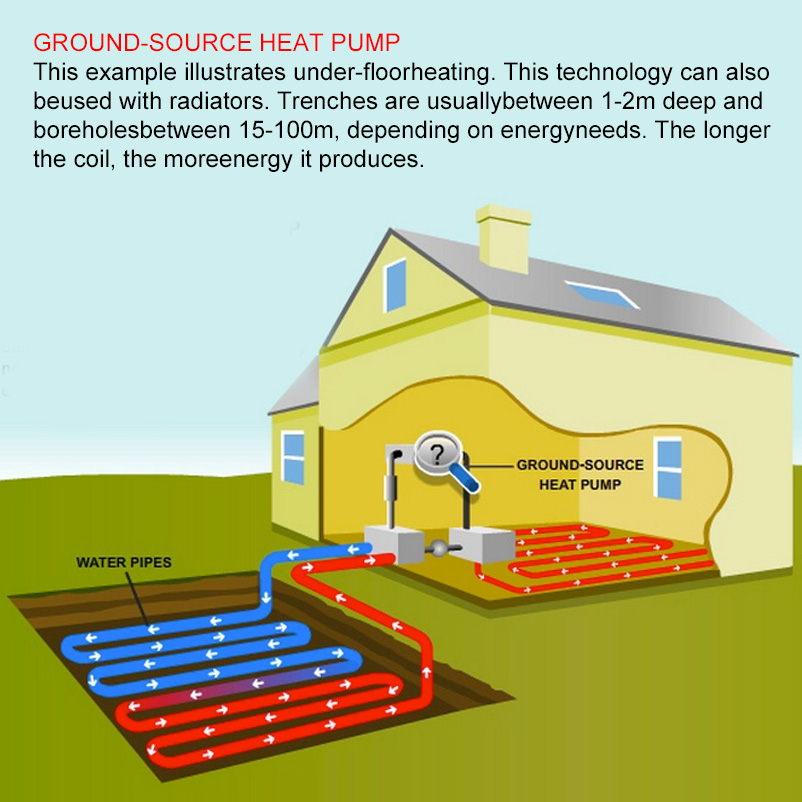
Vertical Boreholes / Vertical (Vertical Ground Loop) – typically U‑pipe installed in boreholes 60–150 m deep. This is the mainstream choice for commercial/residential projects because it offers much better heat exchange performance and requires little land area, despite higher initial drilling cost.
Horizontal Trenches / Horizontal (Horizontal Ground Loop) – shallow burial, lower initial cost, but much lower heat exchange performance and requires large land area (roughly 1–2 times the building’s heated area).
2.4 Heat Pump Unit Efficiency & Operating Strategy
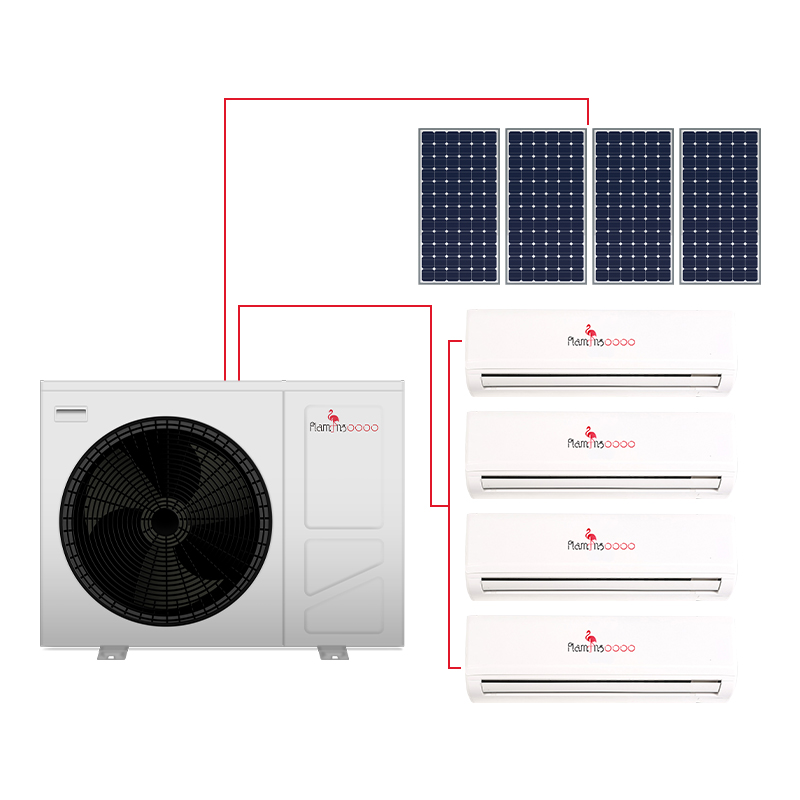
Flamingo water‑source & ground‑source heat pumps are inherently 30% more efficient than conventional air source heat pumps. With the PV Direct Drive function, overall energy savings can exceed 60%. A higher‑efficiency unit reduces the total heat that must be exchanged with the ground, thereby allowing a shorter ground loop.
2.5 Other Engineering Variables
Industry standards (e.g., DB41/T 3058‑2025) clearly state that ground loop length must be determined based on load characteristics, pipe material, rock/soil properties, grout thermal properties, and more. No universal formula works for all projects.
3. Practical Estimation of Loop Length Using Heat Exchange Capacity
In practice, engineers use “heat exchange capacity per unit borehole depth” to estimate loop length, but only after a thermal response test.
Typical Reference Values
Vertical boreholes: 70–110 W/m of borehole depth, or 35–55 W/m of pipe length. For residential projects, borehole depth is typically 80–150 m.
Horizontal trenches: 20–40 W/m of pipe length; trenches 1–2 m deep.
Example (for reference only)
Some DIY GSHP references suggest roughly 600 feet (183 m) of piping per ton of cooling capacity. A 4‑ton system would need about 2,400 feet (730 m) of loop.
However, never use such empirical data without local TRT and design. As Flamingo’s engineers emphasize: Only a site‑specific, custom‑designed ground loop guarantees 20+ years of stable, efficient operation.
4. Flamingo’s Technological Innovations & Performance Advantages
Once the required loop length is determined, high‑quality equipment makes the loop truly effective. Flamingo has demonstrated remarkable technical strength in this field.
Core Product Highlights
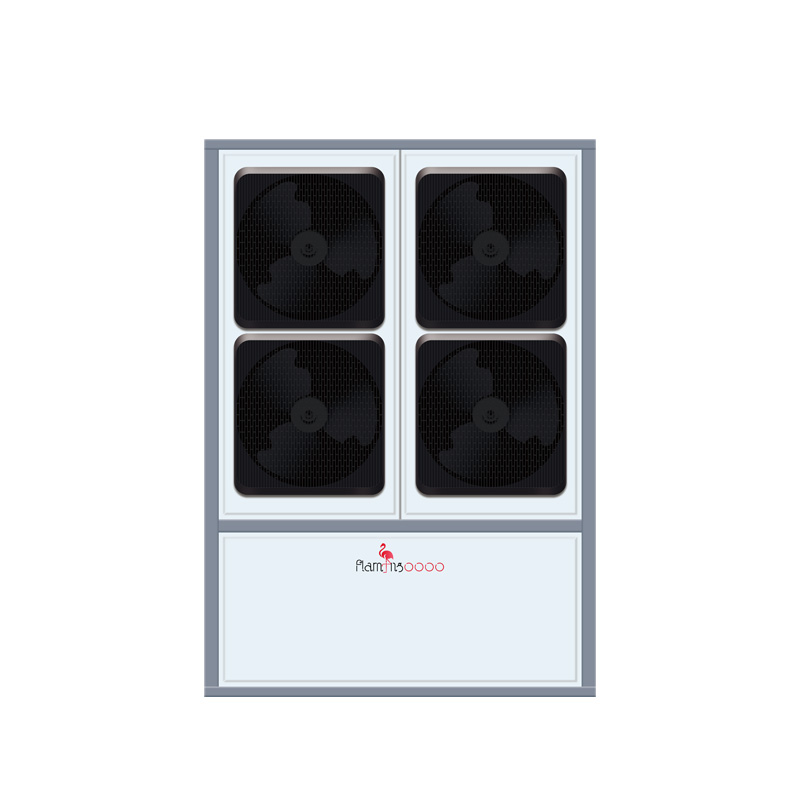
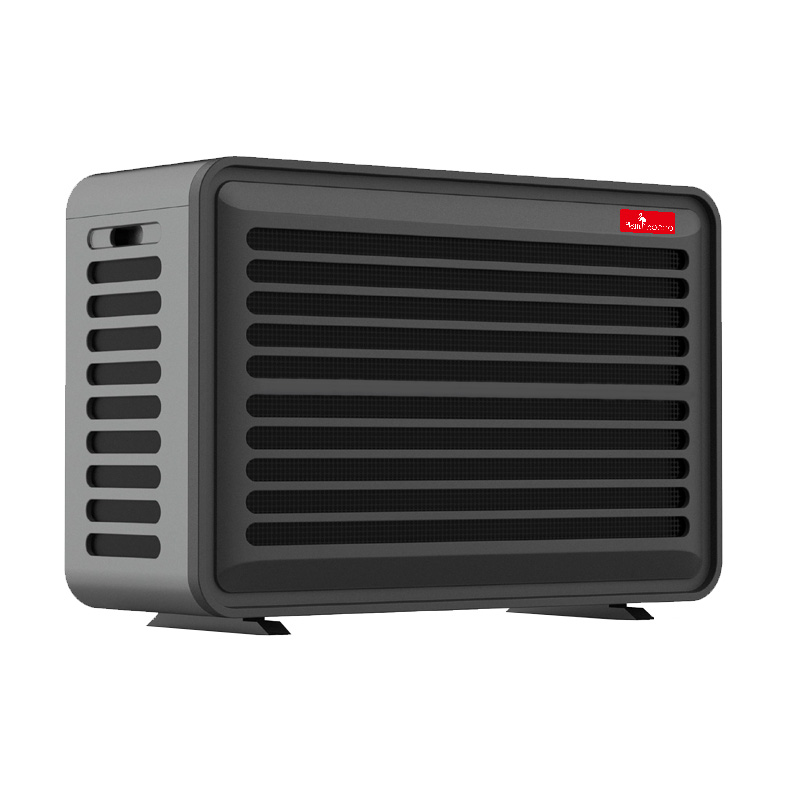
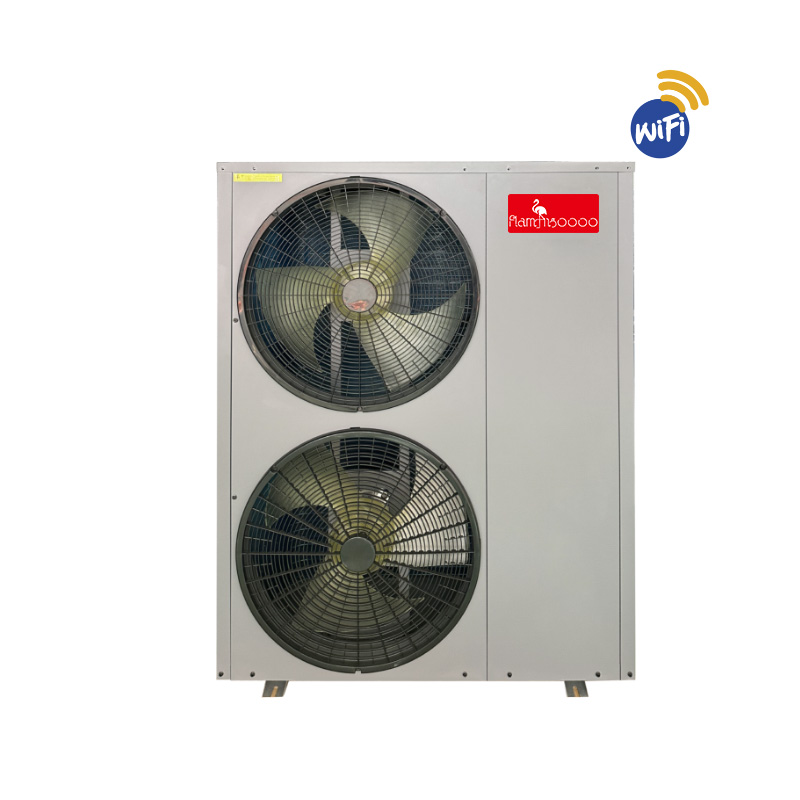
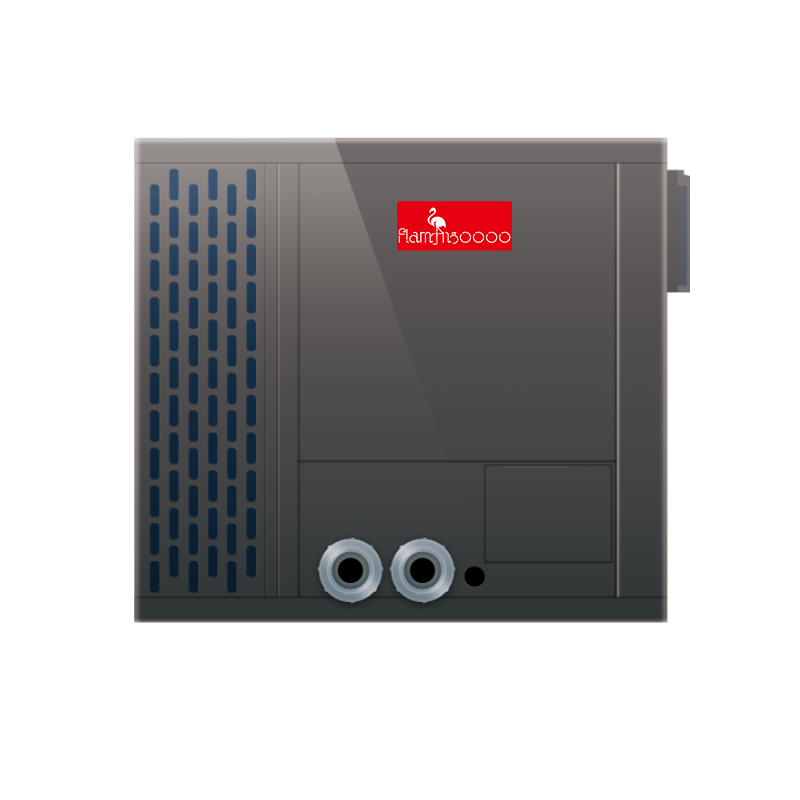
Flamingo’s GSHP/WSHP products integrate DC inverter and intelligent control technologies:
Dual‑system design + liquid cooling for high efficiency and reliability
PV direct drive – can be powered directly by solar PV, enabling near‑zero operating cost
AI intelligent regulation and proprietary wired control
Base energy saving ≥30%; with PV direct drive, total saving ≥60%; zero harmful emissions, no fluorine/chlorine substances
Wide Application Coverage
Flamingo’s portfolio covers multi‑energy complementary low‑carbon systems for villas, hotels (heat recovery), large commercial complexes, and industrial parks.
At ISH China 2025, Flamingo showcased four innovative products, including the 30‑hp PV Direct Drive Water‑Source Heat Pump. The booth attracted global attention, especially from European, Middle Eastern, and Southeast Asian buyers. A German HVAC engineer commented: “PV direct drive solutions have huge potential in Europe – Flamingo’s technical maturity is truly impressive.”
From World‑First to Continuous Leadership
Starting with the world’s first R410 inverter ground‑source heat pump, Flamingo (founder Zou Zhizhong) has continuously broken technological barriers. At ISH China & CIHE 2026, Flamingo launched even more advanced products: Magnetic Bearing Heat Pump, PV Direct Drive CO₂ Heat Pump, and liquid cooling units for data centers – addressing industrial high‑temperature steam and ultra‑low energy cooling applications.
As founder Zou Zhizhong stated: “Flamingo will continue to integrate heat pump technology with renewable energy, launching more efficient, smarter, and more reliable products to meet global low‑carbon heating transformation needs.”
5. Key Installation Details for the Ground Loop
With correct loop length and efficient heat pump units, proper installation ensures long‑term performance.
5.1 Plant Room & Pipe Routing
Locate the plant room as close as possible to the borehole field / loop area to minimize connecting pipe length. Leave at least 1.2 m clearance around the unit for maintenance.
5.2 Drilling & Grouting Quality
Vertical boreholes typically 80–150 m deep with 4–6 m spacing to avoid thermal short‑circuiting. Use high‑thermal‑conductivity grout (e.g., sand or special grout) to enhance heat transfer.
5.3 Pressure Testing & System Flushing
After installation, conduct a 0.8 MPa hydrostatic test for 24 hours to ensure no leakage. Flush at a velocity ≥ 1.5 m/s and vent all air via automatic air vents.
5.4 Well Sediment Control
For large‑diameter water wells, install a sedimentation tank and a filter at the wellhead. Clean regularly. Ensure well flow meets unit requirements (approx. 0.5 m³/h per 10 kW cooling capacity).
5.5 Pipe Welding & Corrosion Protection
Steel pipes must be corrosion‑protected (e.g., epoxy coating) after welding. Insulation thickness depends on local climate (north vs. south).
5.6 Smart Control System Deployment
To fully utilise Flamingo’s efficiency, install temperature/humidity sensors, flow meters, and remote monitoring. With IoT, GSHP systems are moving towards intelligent operation + multi‑energy complementarity.
6. Policy Drivers & Market Trends – A Golden Era for GSHP
The question of loop length sits within a booming global heat pump market.
Global Market Size Continues to Grow
The global GSHP market is projected to grow from ~
The global GSHP market is projected to grow from ~11.3–13.8billionin2025to 11.3–13.8billionin2025to 22.1–22.6 billion by 2034, at a CAGR of 5.68–7.76% (2026‑2034). Another estimate puts the water‑source & ground‑source heat pump market at ~$4.258 billion in 2024, with a CAGR of 4.5% (2024‑2029). Though numbers vary by methodology, all point to strong growth.
As consumers and businesses focus on energy costs and carbon emissions, demand for GSHP is expected to rise steadily.
Policy Acceleration
EU REPowerEU urges member states to redirect €88 billion/year from fossil fuel boiler subsidies towards heat pumps. The revised EPBD phases out support for standalone fossil boilers from 2025. In 2025, 16 European countries saw 11% heat pump sales growth, reaching 28 million units installed (6.62% penetration).
Many European countries offer 30–50% subsidies for heat pump installation. The US Inflation Reduction Act provides up to $8,000 tax credit per heat pump. China’s northern “coal‑to‑electricity” programs cover ≥50% of equipment cost.
Over 130 countries have proposed carbon neutrality targets, creating vast market space for heat pumps.
China’s Global Opportunity
As the world’s largest heat pump production base, China accounted for 58% of global air‑source heat pump production in 2024 (~4.456 million units). Over 50% of China’s exports go to Europe. Rising energy prices due to geopolitical tensions further accelerate European demand for clean heating – creating an unprecedented strategic window for Flamingo and other Chinese heat pump brands to expand globally.
China’s own Dual‑Carbon strategy also drives domestic demand. The 14th Five‑Year Plan explicitly promotes heat pumps for clean heating. By 2025, China’s heat pump heating area is expected to exceed 2 billion m², with a market space exceeding RMB 400 billion.
7. Customer Cases & Future Outlook
Diverse Application Scenarios
Flamingo’s water‑source & ground‑source heat pumps have been successfully installed in factories, schools, hotels, garden villas, and more – any place needing cooling, heating, and/or hot water.
Technical Exchange Impact
At the 2025 HPE China Heat Pump Expo, Flamingo’s PV direct drive technology drew strong interest from heating engineers nationwide and international buyers. One northern China engineer commented: “Flamingo has achieved a major breakthrough in energy saving – greatly reducing operating costs while meeting environmental requirements. The market prospect is broad.”
Industrial & Commercial Dual Drive
Besides traditional HVAC for buildings, Flamingo’s units also meet industrial process heating and cooling demands, including high‑temperature applications.
8. Conclusion & Outlook
Answering “How much piping is required for a Ground Source Heat Pump?” is a process that integrates modern energy science and advanced engineering. From accurate load determination to precise geological parameters, from heat exchange formulas to optimised loop layouts – no single loop length fits all projects. Each GSHP system must be custom‑designed using a thermal response test and dynamic annual load simulation to prevent soil thermal imbalance.
And the ultimate value of this scientific process must be realised through a reliable, high‑efficiency heat pump unit. Flamingo water‑source & ground‑source heat pumps – with their 30‑60%+ energy savings, AI intelligent control, and PV direct drive – provide a complete green solution from ground loop → heat pump unit → smart control system.
Looking ahead, as global carbon neutrality accelerates, energy costs rise structurally, and cross‑field heat pump technologies evolve, Chinese brands with independent intellectual property like Flamingo will play an increasingly vital role in the global clean energy wave.
Flamingo will continue to deeply integrate heat pump technology with renewable energy, rooted in China’s manufacturing strength, seizing the historic opportunity of global low‑carbon transformation, and delivering reliable Chinese solutions for a low‑carbon building, industrial, and social future.
