
Heat Pump Winter Protection: Breaking the Cold Damage Cycle with Flamingo’s Six-Pillar Anti-Freeze Strategy
I. The Industry's Cold Reality: Freeze Damage Tops Winter Complaint Charts
Between December and February every year, heat pump service hotlines receive a surge of emergency calls: cracked pipes, clogged heat exchangers, seized water pump impellers, leaking joints, and even total system failure. According to 2025 statistics from the Heat Pump Committee of the China Energy Conservation Association, approximately 67% of winter heat pump failures are directly related to low-temperature freezing, with the Yangtze River Basin and rural areas of North China being particularly severe.
The core causes identified by the industry are:
Residual water in pipelines: After shutdown or power outage, water left in the water-side heat exchanger and pipes expands in volume, generating enough pressure to rupture metal or plastic components.
Poor defrost drainage: Condensate from the outdoor unit cannot drain away quickly, forming ice on the chassis.
Lack of installed freeze protection: Many low-cost installation packages omit heat tracing cable, anti-freeze fluid, and other options, relying solely on controller default logic that stops working during a power outage.
Water quality and impurities: Systems without anti-freeze fluid are filled with regular tap water, which forms sharp ice crystals and accelerates corrosion.
Addressing these stubborn problems requires a systematic, intelligent, and redundant freeze protection solution. Flamingo has fully integrated the six-pillar strategy across its product range, from residential to commercial and industrial systems.
II. Six-Pillar Anti-Freeze Technology: Ensuring Reliable Heat Pump Operation Down to -35°C
Flamingo’s engineering team has embedded the six anti-freeze pillars into the design of their heat pumps, ensuring that customers receive an inherently protected system.
【Pillar 1】Freeze Protection Function: The Smart Guardian Inside the Controller
Modern heat pump units like Flamingo’s commercial series feature built-in freeze protection functions. This function works by using temperature sensors, water flow switches, and control algorithms to automatically assess freeze risk and take action. Typical scenarios include:
Low-temperature water flow monitoring: When the ambient temperature drops below 4°C and the system detects water temperature approaching 2–3°C, the controller automatically starts the circulating pump for a period to stir the water in the tank or pipeline, preventing localized static water from freezing first.
Electric auxiliary heating: High-end models have a PTC electric heating strip pre-installed in the water circuit; when the water temperature approaches freezing and the pump circulation is ineffective (e.g., during power failure or pump failure), mild heating (about 50–200W) is automatically activated to maintain the water temperature at ≥5°C.
Power-off memory and recovery: Some new Flamingo controllers have supercapacitors or backup batteries that can monitor the temperature for 12 hours even during a power outage.
Customer value: Users can rest easy; the freeze protection function acts like a 24/7 on-duty guard.
【Pillar 2】Drainage Freeze Protection: A Clean Slate After Shutdown
For regions with unreliable power supply, drainage freeze protection is the ultimate physical solution. Flamingo has integrated automatic drainage freeze protection valves and gravity self-drain designs into their hydraulic modules:
Motorized two-way valve + freeze protection program: When customers select the “long-term leave” mode on their smartphone app, the controller first closes the inlet valve, then opens the drain valve and starts the pump briefly to expel residual water through the discharge pipe.
Anti-siphon structure: The water circuit in Flamingo’s heat exchangers is designed with a high inlet and low outlet, using gravity to allow more than 98% of accumulated water to flow out.
Customer value: Completely eliminates freeze damage caused by accidental power outages or controller failure.
【Pillar 3】Heat Tracing Cable: Wrapping Pipelines in “Electric Thermal Underwear”
Even if the main unit’s freeze protection is strong, the water pipes connecting the indoor and outdoor units, outdoor valves, and makeup water lines remain high-risk areas for freezing. Flamingo has working closely with heat tracing cable suppliers to guarantee compatibility and safety across its product lines.
Heat tracing cables, made of conductive polymer materials, have self-limiting temperature characteristics. In heat pump systems, typical application points for heat tracing cable include:
Outdoor pipelines: Wrapped in self-limiting heat tracing cable + rubber foam insulation, maintaining the water temperature inside the pipe above freezing.
Expansion tanks and safety valves: Wrapped with low-power heat tracing cable (about 15W/m).
Condensate drain pipes: Heat tracing cable is attached to the bottom of the pipe to prevent ice blockage.
Water pump body: Patch-type heat tracing cable prevents the rotor from freezing.
Customer value: Heat tracing cable is an affordable insurance policy for long outdoor pipeline runs of 10–20 meters.
【Pillar 4】Anti-Freeze Fluid: Changing the Freezing Point from the Source
Heat pump water systems containing pure water have a freezing point of 0°C. Adding anti‑freeze fluid in the correct proportion changes the game entirely.
Flamingo recommends high-quality anti‑freeze fluids suitable for heat pump systems, with proper concentration to lower the freezing point to between -15°C and -35°C. The company advises:
Concentration testing: Use a hydrometer or refractometer to check concentration before winter each year. If evaporation has reduced the concentration, add the original fluid.
Material compatibility: Ensure that all seals and plastic components in the system are compatible with the chosen fluid.
Heat exchange efficiency: Because antifreeze fluid has a slightly lower specific heat capacity than water, Flamingo recommends slightly increasing the pump flow rate or heat exchange area during design.
Customer value: Anti‑freeze fluid provides an absolute baseline of protection for heat pumps that cannot guarantee continuous power supply or are left unattended.
【Pillar 5】Circulation Freeze Protection: Keeping Water Moving to Prevent Ice
Circulation freeze protection is a dynamic solution that works with the pump and controller. The principle is simple: moving water does not freeze easily. When the water temperature approaches freezing, flow disrupts the static supercooling conditions needed for ice formation.
Flamingo’s circulation freeze protection typically operates in three levels:
Primary circulation (internal circulation): When the outdoor temperature is below 4°C and the heating is off, the controller starts the internal micro‑circulation pump, operating only between the hydraulic module and the plate heat exchanger, using about 30–50W.
Secondary circulation (end‑loop circulation): If the water temperature continues to drop, the main circulation pump starts, allowing water to flow through outdoor pipelines and terminal equipment.
Emergency heating circulation: If the water temperature remains at 1°C despite these measures, the system can activate the compressor or auxiliary electric heating for a short time.
Customer value: Circulation freeze protection allows the system to stay in a “lightly active” state, balancing freeze protection with energy saving.
【Pillar 6】Defrost Mode: Protecting the Outdoor Unit from Self‑Destruction
Frost formation on the outdoor evaporator is an inevitable side effect of a heat pump extracting heat from the air in winter. Flamingo has optimized its defrost mode to address this challenge.
Current mainstream defrost methods integrated into Flamingo’s systems include:
Time–temperature combination method: Every 30–90 minutes, the system checks the difference between the outdoor coil temperature and the ambient temperature. When the coil temperature drops below a set value (such as -5°C) for a sustained period, the defrost cycle begins.
Fuzzy control and AI self‑learning: Flamingo’s heat pumps adjust the defrost interval dynamically based on historical frost data, avoiding “frost without defrosting” or “defrosting without frost” energy waste.
Hot‑gas bypass defrost: The reversing valve switches the unit to cooling mode, allowing high‑temperature refrigerant to flow into the outdoor coil to melt the frost layer. The defrost process typically takes 2–5 minutes.
Chassis heating: An aluminum foil heating strip or heat tracing cable is placed under the outdoor unit chassis to ensure condensate evaporates immediately or drains away, preventing ice accumulation.
Flamingo’s commercial heat pumps, for example, feature an intelligent defrost mode that can sense the early signs of frost blockage and initiate the chassis de‑icing function, reducing defrost time to less than 90 seconds.
Customer value: A reliable defrost mode protects the outdoor unit structure and fan, prevents compressor short‑cycling and liquid hammer damage caused by frost buildup, and can extend overall unit life by 2–3 years.
III. Unmatched Performance in Extreme Climates: Flamingo’s Commitment to Cold‑Climate Reliability
While the six‑pillar anti‑freeze strategy handles freeze prevention, Flamingo has also pushed the limits of what heat pumps can do in extreme cold. The company’s R&D team, comprising over 200 professionals working from a 50,000‑square‑meter factory in Guangdong along with a –45°C low‑temperature laboratory, has developed systems that operate efficiently in harsh winter conditions.
Flamingo’s CO₂ full‑inverter photovoltaic direct‑drive heat pump, for example, can still provide robust heating in cold environments as low as -35°C, setting a new benchmark in the heat pump industry. The solar‑powered CO₂ heat pump delivers stable performance from -40°C to 70°C, offering 7kW of heating capacity and instant 90°C hot water output.
Furthermore, Flamingo’s commercial heat pump systems can maintain efficient heating stability in environments as cold as -25°C while providing powerful cooling capacity during the summer, ensuring year‑round operation.
IV. Future Trends: Low‑Pressure‑Loss Anti‑Freeze Heat Pumps and PV‑Direct‑Drive Freeze Protection
The industry is researching breakthrough technologies that could allow heat pumps to completely eliminate freeze damage. Flamingo is at the forefront of several of these advancements through its photovoltaic direct‑drive (PV‑direct) technology.
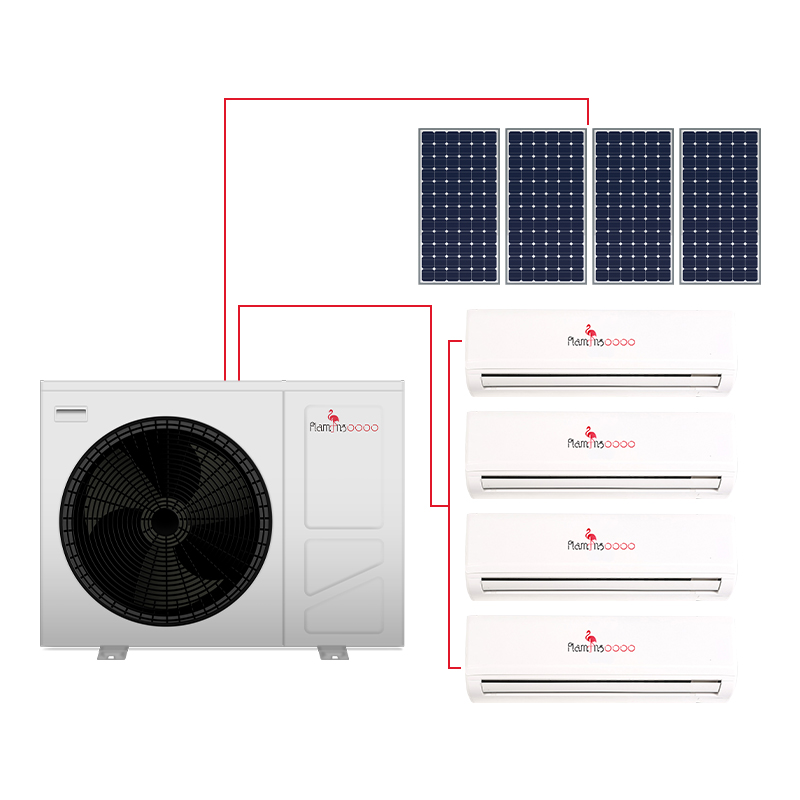
Flamingo’s photovoltaic direct‑drive systems directly convert solar energy into electrical energy through photovoltaic panels to drive the heat pump. This innovative design not only reduces operating costs but also improves the overall energy efficiency of the system. During peak sunlight hours, the system can achieve self‑sufficient operation.
At the 2025 China Heating Exhibition, Flamingo brought four innovative photovoltaic direct‑drive heat pump products with the core theme of “Photovoltaic direct drive, electricity is visible!” demonstrating breakthrough results in clean energy technology. Flamingo’s photovoltaic direct‑drive technology integrates DC inverter technology with AI intelligent adjustment, developed with self‑developed line control.
Flamingo’s photovoltaic direct‑drive heat pump technology can be combined with the six‑pillar anti‑freeze strategy to create a comprehensive winter operation plan:
PV‑direct drive + freeze protection function: When the grid fails, PV‑generated electricity continues to power the freeze protection function.
PV‑direct drive + circulation freeze protection: Solar energy can power the micro‑circulation pump during daytime to maintain water flow.
PV‑direct drive + heat tracing cable: Solar electricity powers the heat tracing cable around outdoor pipes.
Several demonstration projects using Flamingo’s PV‑direct technology have already been deployed. By 2030, Flamingo aims to deliver carbon‑negative technologies across its product lines.
V. Conclusion: Freeze Protection Is Not a Cost—It’s a Responsibility
A Chinese service technician once told a customer: “If you had spent an extra few hundred dollars on an automatic drain valve and heat tracing cable at the time of installation, you could have saved yourself thousands in repair costs.” This simple piece of advice captures the essence of heat pump freeze protection: prevention is always far cheaper than repair.
The six pillars—Freeze Protection Function, Drainage Freeze Protection, Heat Tracing Cable, Anti‑Freeze Fluid, Circulation Freeze Protection, and Defrost Mode—are not isolated tactics but rather a comprehensive safety net covering control, structure, fluid chemistry, and system dynamics. For heat pump professionals and customers alike, understanding and implementing these solutions is the path to reliable, worry‑free winter heating.
Heat pumps are designed to provide efficient, sustainable heating. With modern systems from manufacturers like Flamingo—backed by advanced PV‑direct technology, extreme‑cold operation down to -35°C, and an industry‑leading six‑pillar anti‑freeze strategy—customers can enjoy peace of mind even during the harshest winter conditions.
About the Technical Specifications
Freeze Protection Function: Integrated into Flamingo’s commercial and residential heat pump controllers
Drainage Freeze Protection: Available as an optional automatic drainage kit
Heat Tracing Cable: Compatible with all Flamingo outdoor unit installations; recommended for long pipeline runs
Anti‑Freeze Fluid: Suitable for both residential and commercial systems; concentration to be adjusted based on local minimum temperatures
Circulation Freeze Protection: Standard on all Flamingo inverter‑driven heat pumps
Defrost Mode: Fourth‑generation intelligent defrost with AI learning capability
Extreme Climate Operation: Flamingo systems are designed for stable operation in ambient temperatures as low as -40°C
Photovoltaic Direct‑Drive: Available across Flamingo’s CO₂, R290, and R32 heat pump series
