
Do Heat Pump Units Need a Circulating Water Pump? A Full Analysis from System Selection to Efficiency Upgrade – Based on Flamingo’s Product Practice
As China’s “dual carbon” strategy deepens and the green & low‑carbon concept continues to take hold, heat pump technology – as a core tool for clean heating and cooling – is facing unprecedented opportunities. The industry standard NB/T 11507-2024 Code for Selection and Installation of Water Pumps for Air Source Heat Pump Systems, issued by the National Energy Administration in May 2024 and effective from November 2024, as well as the national standard Technical specification for greenhouse gas emission reduction assessment of building heat pump systems (draft for public comment by the Ministry of Housing and Urban‑Rural Development in January 2026), both mark a new phase of standardisation and energy‑efficiency management for heat pump systems.
Nevertheless, a fundamental but often misunderstood question keeps troubling many installers and end users during the design, selection and installation of heat pump systems: Do heat pump units really need a circulating water pump?
As a technology‑driven enterprise focusing on inverter heat pumps and PV‑direct heat pumps, Guangdong Flamingo New Energy Technology Co., Ltd. (hereinafter “Flamingo”) has accumulated rich system integration experience through years of product development and engineering practice. Starting from Flamingo’s product practice, this article systematically answers this core question, incorporating industry standards and the latest technology trends.
The role of the circulating water pump in a heat pump system: not “whether”, but “how”
To answer whether a heat pump unit needs a circulating water pump, we must first understand the basic operating logic of a heat pump system.
The core function of a heat pump unit is to drive a refrigerant cycle via the compressor, absorbing heat from a low‑temperature source (air, ground, water, etc.) and releasing it to a high‑temperature sink (indoor heating terminals, domestic hot water tank, etc.). On the water side, however, water must act as the heat transfer medium – during heating, the heat pump transfers heat to the circulating water flowing through its heat exchanger; the heated water is then transported through pipes to underfloor heating coils, fan coil units, radiators or a hot water tank, releases its heat, and returns to the heat pump to be reheated. The power for this water circulation comes from the circulating water pump.
Therefore, in principle, any water‑based heat pump system that uses water for heat transport must include a circulating water pump – it is an essential component. In practice, the pump can be integrated inside the heat pump unit as part of a hydraulic module, or it can be installed as a separate external component. Industry standard NB/T 11507-2024 makes this clear: it “applies to the selection and installation of circulating water pumps built into air source heat pump units; the selection and installation of external circulating water pumps may refer to this code.”
Flamingo fully embodies this philosophy in its product design. Take the NL‑B1S/R32 compact 3.5 kW air‑to‑water heat pump, designed for small residential projects – it already has a built‑in circulating water pump, expansion tank, backup heater and high‑efficiency plate heat exchanger, greatly reducing dependence on external components and enabling true plug‑and‑play convenience. In its commercial monoblock range, Flamingo also pays close attention to hydraulic integration: the Monoblock commercial air‑to‑water heat pump series covers heating capacities from 11 kW to 230 kW, operates in ambient temperatures from ‑10 °C to 43 °C, and supplies water up to 60 °C, balancing built‑in hydraulic modules with flexible system expansion.
Thus, the circulating pump is a certainty; the variable is how it is integrated and configured. Flamingo’s diverse product portfolio offers complete solutions, from built‑in to external pumps, for different scales and applications.
Built‑in vs. external pump: two configurations in the Flamingo product matrix
Heat pump products on the market mainly fall into two camps regarding circulating pump configuration: built‑in pump inside the unit, and external pump installed separately. With its rich product lines and deep system integration capabilities, Flamingo has mature technology in both configurations.
Built‑in pump solution – integration advantages of Flamingo’s full‑DC inverter products
Flamingo widely adopts the built‑in circulating pump design in its full‑DC inverter heat pump products. The main advantage is simplified system configuration, reduced installation space, and lower on‑site work – especially for residential air‑to‑water heat pumps and small housing projects, where a built‑in pump significantly lowers the technical threshold for installers.
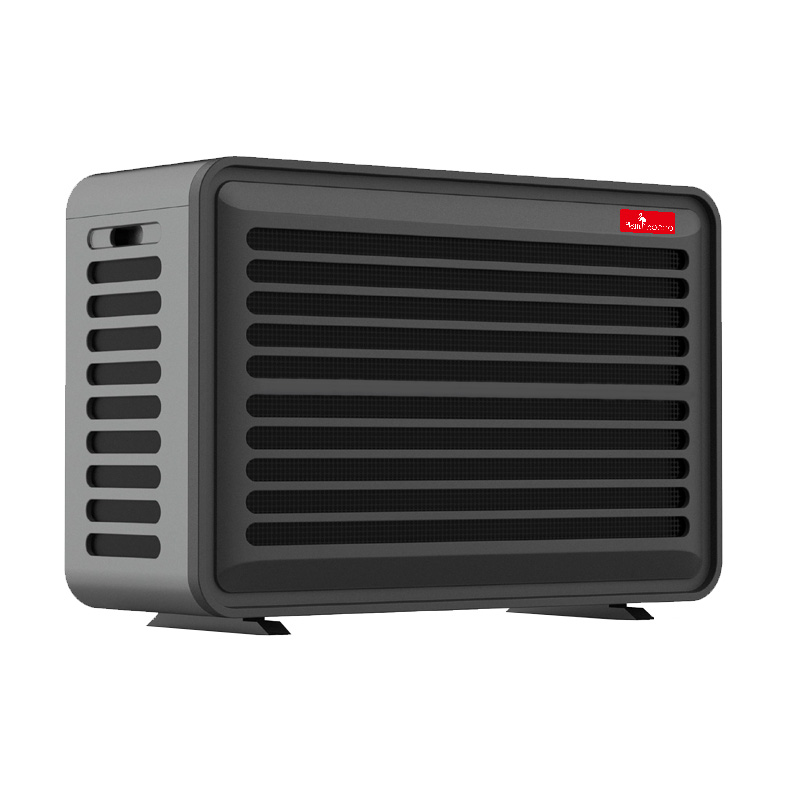
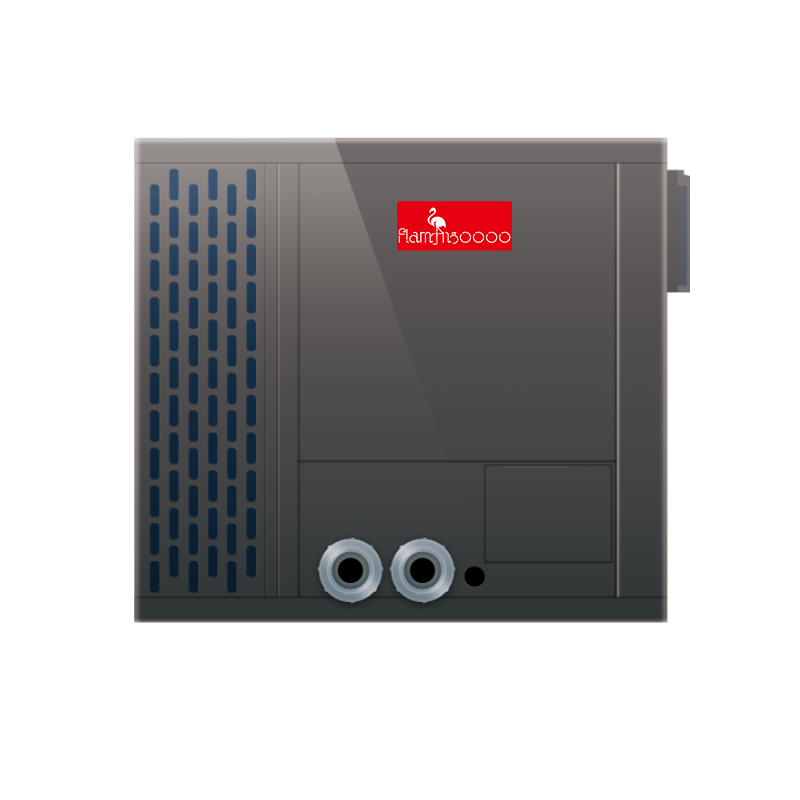
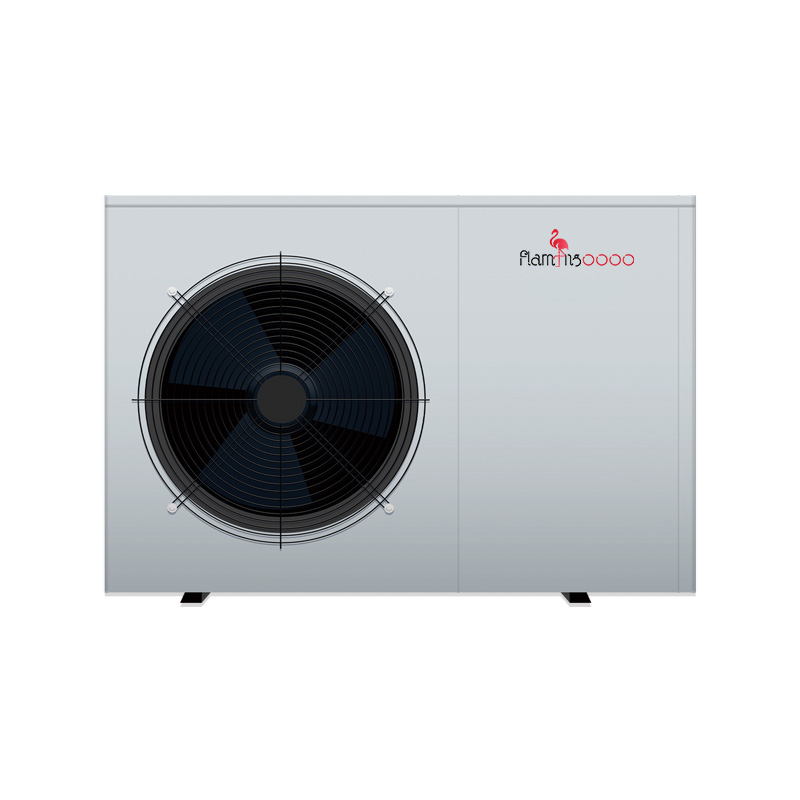
Take Flamingo’s NL‑B1S/R32 heat pump – designed for small residential projects under 35 m². Within a compact footprint of 960 mm × 380 mm × 563 mm, it integrates a circulating water pump, expansion tank, backup heater and high‑efficiency plate heat exchanger. The unit uses a Panasonic EVI twin‑rotor DC inverter compressor, operates at only 35 dB(A), and achieves over 75 % energy savings. The built‑in pump is tightly coupled with the unit, and the whole system provides WiFi smart control and three‑in‑one functionality (heating, cooling, domestic hot water), offering end users a true plug‑and‑play experience.
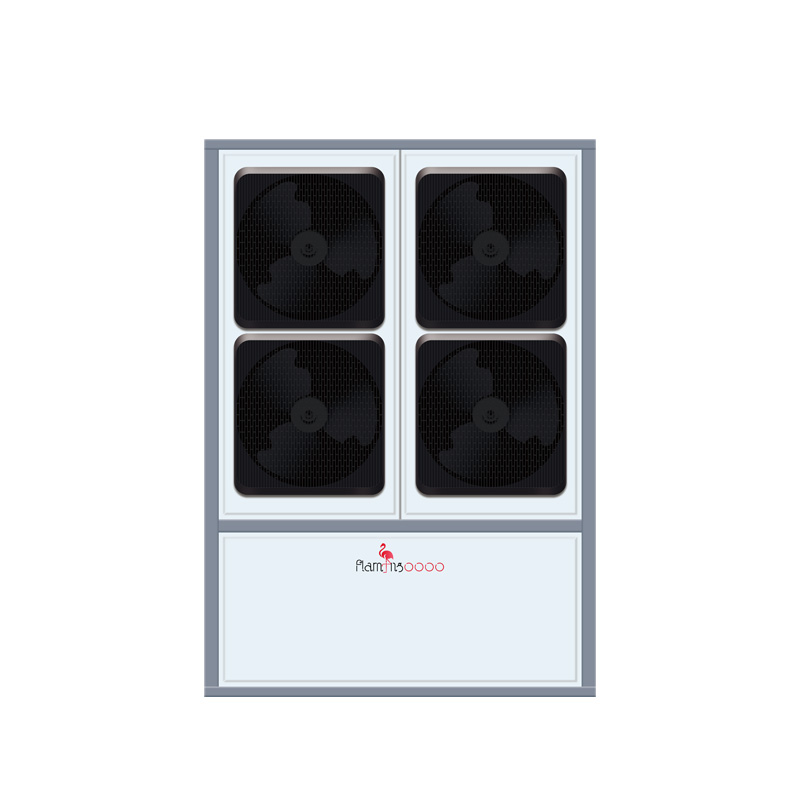
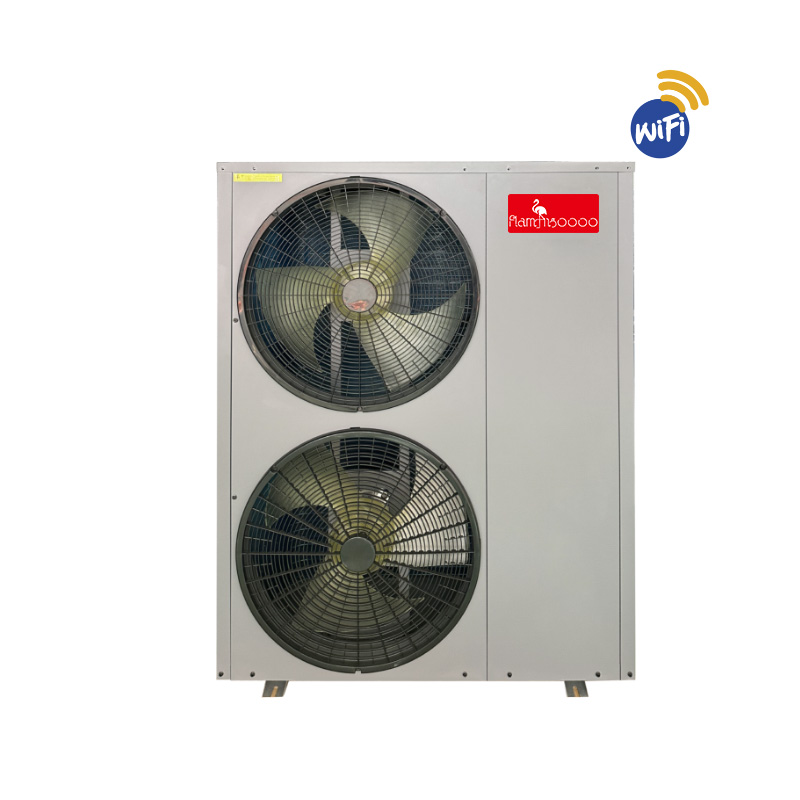
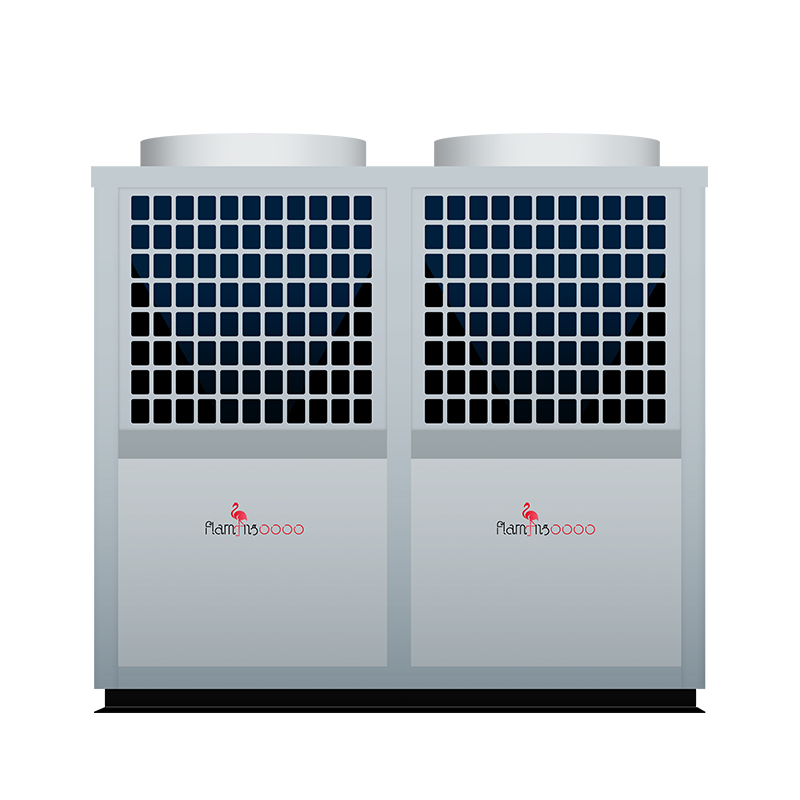
In the commercial field, Flamingo’s Monoblock integrated series also reflects a highly integrated design. The series includes models from FLM‑AH‑003H410 to FLM‑AH‑012H410, with heating capacities from 11.4 kW to 44.7 kW, water flow rates from 2 m³/h to 7.7 m³/h, built‑in well‑known brand compressors, R410a refrigerant, and stable operation across a wide ambient range of ‑10 °C to 43 °C.
External pump solution – flexibility for medium and large systems
For medium‑to‑large heat pump systems, multiple units operating in parallel, or projects with complex piping and demanding hydraulic conditions, an external pump is often the better choice. An external pump can be selected independently according to the system’s actual needs, unrestricted by the unit’s internal space or preset parameters, offering clear advantages in flexibility, expandability and redundancy.
Flamingo has extensive experience with external pump solutions. In a commercial building project in Tianjin, for example, after installing Flamingo heat pumps the winter supply air temperature reached 45 °C and the summer chilled water was as low as 7 °C, with stable operation year‑round. In such medium‑to‑large projects, Flamingo’s technical team custom‑selects circulating pumps based on site hydraulic conditions, ensuring precise matching of flow rate and head with system resistance.
In the Flamingo leisure centre renovation project in Finland, a CO₂ heat pump was used to recover heat from ventilation and wastewater – the first such wastewater heat recovery system in a Finnish real estate project. The external configuration of circulating pumps and the integrated system design in this large‑scale project demonstrate Flamingo’s technical strength in large heat pump system integration.
Flamingo’s technology positioning and product portfolio
To deeply understand Flamingo’s philosophy and practice regarding pump configuration, it is necessary to systematically review the company’s technology positioning and product range.
Technology positioning
Since its founding, Flamingo has focused on two core technology directions: inverter heat pumps and PV‑direct heat pumps. Founder Zou Zhizhong has led the team to continuously tackle the challenges of PV‑heat pump synergy, creating multi‑energy complementary low‑carbon systems. From the world’s first R410 inverter ground‑source heat pump to the implementation of core patents in 2024, Flamingo keeps breaking through industry technical barriers, embedding a solid technology gene into its heat pump products.
At the 2025 China Heat Pump Expo in Shijiazhuang, Flamingo presented four innovative PV‑direct heat pump products under the theme “PV‑direct drive – electricity savings you can see”, showcasing breakthroughs in clean energy technology. In March 2026, Flamingo exhibited again at ISH China & CIHE in Beijing, presenting four “hardcore” heat pump products: a PV ground‑source heat pump, a PV‑direct CO₂ heat pump, a magnetic‑bearing heat pump, and a liquid‑cooled energy storage chiller, covering data centre cooling, building combined heating/cooling, industrial high‑temperature steam, and ultra‑low energy cooling. These products received wide acclaim from domestic and international customers.
Product portfolio overview
Flamingo’s product lines cover residential, commercial and industrial applications, including the following series:
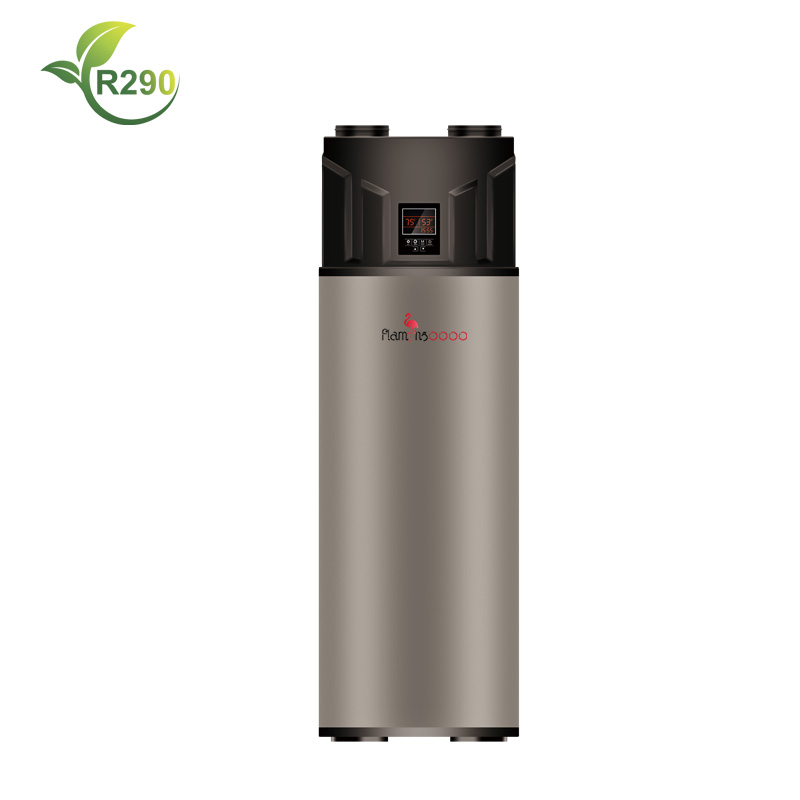
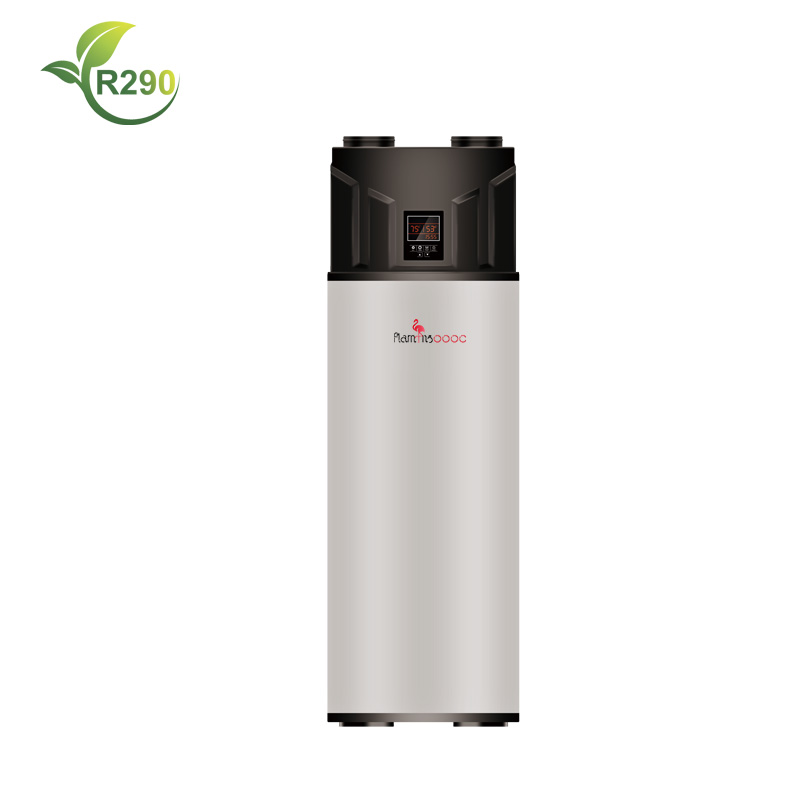
Residential & small commercial series: Represented by the NL‑B1S/R32, a 3.5 kW full‑DC inverter three‑in‑one heat pump with built‑in circulating pump, expansion tank and backup heater, suitable for residential projects under 35 m²; R134a integrated air‑to‑water heat pump water heater with 300 L tank, maximum outlet temperature of 75 °C, and WiFi remote control.
Commercial Monoblock series: 11 kW to 230 kW integrated air‑to‑water heat pumps, models FLM‑AH‑003H410 to FLM‑AH‑012H410, operating range ‑10 °C to 43 °C, outlet water up to 60 °C, suitable for central hot water and heating systems.
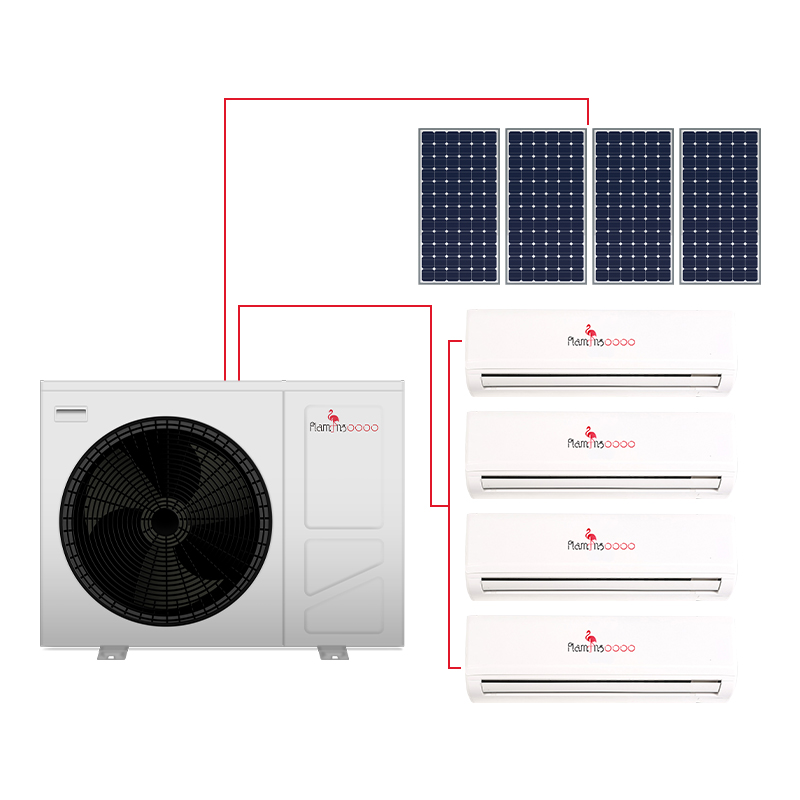
PV‑direct heat pump series: Including a 30 HP PV‑direct water‑to‑water ground‑source heat pump, a 6 HP PV‑direct DC inverter air‑to‑water heat pump, a 2 HP PV‑direct CO₂ heat pump, etc., reducing grid dependence and saving up to 70 % energy.
Industrial CO₂ heat pump: Uses R744 (CO₂) natural refrigerant, operates stably in the wide range of ‑40 °C to 70 °C, outlet water temperature up to 90 °C or higher, suitable for industrial high‑temperature steam applications.
Magnetic‑bearing heat pump & liquid‑cooled energy storage chiller: First shown at ISH 2026, representing Flamingo’s exploration of cutting‑edge applications such as data centre cooling and ultra‑low energy cooling.
Quality and production capacity
Flamingo has a modern R&D and production base in Foshan, Guangdong, covering 50,000 m², with six production lines, including a ‑45 °C low‑temperature laboratory and an R290 explosion‑proof line, ensuring reliability under extreme conditions. The company has a professional team of over 200 people and has obtained ISO 9001 certification and 12 patents in renewable energy.
Standard first: NB/T 11507-2024 sets rules for pump selection – Flamingo responds actively
On 24 May 2024, the National Energy Administration officially issued industry standard NB/T 11507-2024 Code for Selection and Installation of Water Pumps for Air Source Heat Pump Systems, effective from 24 November 2024. This standard fills a long‑standing gap in specialised technical specifications for water pumps in air‑source heat pump systems.
The standard systematically covers four dimensions: selection, installation, commissioning/acceptance, and maintenance.
Selection requirements: Specifies calculation methods for key parameters such as flow rate, head and power, emphasising that the selection must be based on the specific needs of the air‑source heat pump system to ensure that the pump meets operating conditions.
Installation specifications: Defines requirements for pump location, installation method, pipe connections, etc., emphasising safety and reliability to ensure stable operation and high system efficiency.
Commissioning & acceptance: Specifies the testing and acceptance process after pump installation, requiring performance tests to verify that design requirements are met.
Maintenance & care: Provides guidance on daily inspection, cleaning, lubrication, etc., to extend pump life and maintain long‑term stable operation.
As a provider of complete heat pump system solutions, Flamingo is actively integrating these standard requirements into its product design and engineering services. When providing system design for customers, Flamingo’s technical team strictly follows the standard’s methods for calculating flow and head, ensuring that every system operates at its optimal energy efficiency range.
Meanwhile, the national standard Technical specification for greenhouse gas emission reduction assessment of building heat pump systems (draft for public comment by MOHURD in January 2026) will make the carbon reduction benefits of heat pump systems more quantifiable and transparent. As the pump is a major energy consumer in the system, its efficiency will face more scrutiny. Flamingo’s continued investment in inverter technology and PV‑direct drive is a forward‑looking response to this trend.
Flamingo’s energy efficiency practice: permanent‑magnet inverter and PV‑direct technology
If past discussions on “whether a heat pump needs a circulating pump” stayed mainly at functional necessity, today the more important question is: “what kind of circulating pump achieves the best energy efficiency?”
The circulating pump runs for long hours all year, so its efficiency directly affects the overall energy consumption of the heat pump system. Flamingo’s technological innovation at the system level provides a valuable reference.
Full‑DC inverter technology – reducing consumption at the source
One of Flamingo’s core technology strengths is the deep application of full‑DC inverter technology. Both compressor and fans use DC inverter solutions, enabling precise regulation based on actual load demand.
Flamingo’s new CO₂ full‑DC inverter PV‑direct heat pump operates stably and efficiently even at ‑35 °C. Full inverter technology is not limited to the heat pump unit – it also runs through the hydraulic module design. Flamingo’s technical team always recommends inverter circulating pumps for system integration, so that pump power varies dynamically with system load, avoiding the “big horse pulling a small cart” energy waste of fixed‑speed pumps under partial load.
PV‑direct technology – pushing the energy saving boundary to the extreme
At several exhibitions in 2025 and 2026, Flamingo prominently displayed PV‑direct heat pump technology. This technology uses PV panels to convert solar energy directly into electricity to drive the heat pump, significantly reducing grid electricity consumption during sunny hours.
Take the 30 HP PV‑direct water‑to‑water ground‑source heat pump – it features dual system design, liquid cooling, PV‑direct drive, and AI intelligent regulation. A ground‑source heat pump alone saves 30 % energy compared to an air‑source unit; adding PV‑direct drive pushes total energy savings above 60 %. The 6 HP PV‑direct DC inverter air‑to‑water heat pump uses R32 refrigerant, suitable for single‑system PV applications and a wide range of residential uses.
Flamingo’s CO₂ full‑DC inverter PV‑direct heat pump combines multiple advanced technologies: natural CO₂ refrigerant (ODP = 0, GWP = 1), AI‑driven optimisation increasing efficiency by over 30 %, and stable operation under extreme climate conditions. This product has attracted wide global customer interest.
System‑level energy efficiency
Flamingo’s commercial heat pump systems can achieve a comprehensive COP of 6.0 or higher – meaning that for every 1 kWh of electricity consumed, 6 units of heat are transferred, far exceeding traditional heating systems. Compared to conventional heating/cooling systems, Flamingo heat pumps reduce electricity consumption by 32 % and gas costs by 48 %.
In a commercial building project, using Flamingo heat pumps saves 292.05 tonnes of standard coal per heating season, while reducing CO₂ emissions by 759.34 tonnes, SO₂ by 1.87 tonnes and NOx by 2.22 tonnes. In the Dagang Oilfield shallow geothermal project, the heat pump system reduced CO₂ emissions by 15,000 tonnes in a single heating season.
These figures show that the overall energy efficiency of a heat pump system depends not only on the unit’s performance but also on the precise coordination of the hydraulic system, including the circulating pump. Flamingo’s continuous system‑level optimisation delivers tangible economic and environmental benefits for customers.
Accurate selection: Flamingo’s methodology for pump selection
Whether using a built‑in or external pump, accurate selection is the prerequisite for efficient system operation. Flamingo’s technical team has developed a systematic selection methodology through years of engineering practice.
Flow rate calculation
The pump flow rate should be determined by the total system heat load and the supply‑return temperature difference. For heating systems, the basic formula is:
G = Q × 0.86 / ΔT
Where:
G = circulating water flow rate (t/h or m³/h)
Q = total system heat load (kW)
ΔT = supply‑return temperature difference (°C)
Different terminal systems have different design temperature differences: radiator systems typically 20‑25 °C, underfloor heating 10 °C, air‑source heat pump systems 5 °C.
In practice, a safety factor of 1.1‑1.2 is usually applied. Flamingo’s technical team considers “one duty + one standby” or “two duty + one standby” configurations for commercial projects to ensure reliability.
Head calculation
The pump head must overcome the total pressure drop of the most unfavourable circuit, including:
Internal water resistance of the heat pump unit (varies by model – refer to product data)
Terminal device resistance (fan coil, AHU, etc.): typically 6‑7 mH₂O
Filter resistance: typically 3‑5 mH₂O
Manifold resistance: typically 3 mH₂O
Pipe friction and local losses: typically 7‑10 mH₂O
A rough estimate for pipe friction loss is about 3 mH₂O per 100 m of pipe length. The final pump head should include a 1.1‑1.2 safety factor.
Multiple pumps in parallel and Flamingo’s engineering practice
In medium‑to‑large heat pump systems, multiple pumps operating in parallel are common. A key point: when pumps run in parallel, the total flow is not simply the sum of individual flows – the more pumps, the greater the flow decay. In large projects such as the Flamingo leisure centre in Finland, Flamingo performed detailed hydraulic calculations and system design for parallel operation to ensure balanced water distribution and stable, efficient operation.
For installation, Flamingo pays special attention to the pump location. For inverter pumps, they should preferably be placed in the middle section of the pipe between the tank return port and the farthest water point. For piping, the “reverse return” (same path length) design is recommended – keeping pipe lengths and elbow counts as equal as possible for each unit to minimise hydraulic differences. Horizontal pipes should slope 0.3 % toward the tank, with automatic air vents properly placed.
Application‑specific configuration guide: Pump strategies for different systems with Flamingo products
Flamingo’s diverse product portfolio offers flexible pump configuration solutions for different applications.
Air‑source heat pump systems
Air‑source units are prone to frosting in winter, with fluctuating loads, and are often used in noise‑sensitive residential settings. Flamingo’s NL‑B1S/R32 compact heat pump has a built‑in circulating pump and runs at only 35 dB(A), ideal for homes and offices. The commercial Monoblock series operates from ‑10 °C to 43 °C, suitable for most climate zones in China. For severe cold regions, Flamingo’s CO₂ heat pump operates stably from ‑40 °C to 70 °C, meeting heating needs in extremely cold climates.
Water‑/ground‑source heat pump systems
Ground‑source heat pumps have stable year‑round operating characteristics. Flamingo’s 30 HP PV‑direct water‑to‑water ground‑source heat pump uses a dual‑system design; the ground‑source unit alone saves 30 % energy compared to an air‑source unit, and PV‑direct drive adds further savings. In such systems, the circulating pump should be made of corrosion‑resistant materials and equipped with fine filters to prevent clogging.
Two‑pipe (heating + cooling) systems
Two‑pipe systems (underfloor heating + fan coil cooling) require precise hydraulic coordination. Flamingo’s NL‑B1S/R32 provides “3‑in‑1” functionality (heating, cooling, domestic hot water), with a built‑in pump and expansion tank, greatly simplifying system integration.
CO₂ heat pump systems
Flamingo has achieved breakthroughs in CO₂ heat pumps. The CO₂ full‑DC inverter PV‑direct heat pump uses natural R744 (CO₂) refrigerant (ODP = 0, GWP = 1), excellent environmental performance, and stable operation down to ‑35 °C. The system integrates inverter pump control, adjusting pump speed dynamically according to system load to maximise energy savings under partial load. This product is especially suitable for industrial high‑temperature steam, food processing, textile dyeing, electroplating and other high‑heat‑demand industries.
Industry trends: Flamingo leads in smart, integrated and low‑carbon development
Looking at the heat pump industry from the perspective of 2026, smart, integrated and low‑carbon are the irreversible main trends. Flamingo has made forward‑looking deployments in all these directions.
Smart: Flamingo heat pumps fully support WiFi smart control, remote monitoring, scheduling and energy tracking via the Tuya smart app. AI intelligent regulation allows the system to automatically optimise operation based on environmental changes and user habits. The magnetic‑bearing heat pump and liquid‑cooled energy storage chiller shown at ISH 2026 represent Flamingo’s latest exploration in smart heat pumps.
Integrated: Flamingo’s product line, from residential to commercial monoblocks, reflects a strategic direction of system integration. The integrated hydraulic module combines the circulating pump, expansion tank, safety valve, filter, etc. into a single module, greatly simplifying on‑site installation and lowering the technical threshold for installers.
Low‑carbon: With standards such as MOHURD’s Technical specification for greenhouse gas emission reduction assessment of building heat pump systems, the carbon reduction benefits of heat pump systems will be more quantifiable and transparent. Flamingo has pledged to achieve full application of carbon‑negative technologies by 2030, and has already made substantial progress with CO₂ heat pumps and PV‑direct drive. Flamingo’s CO₂ heat pumps replace traditional fluorinated refrigerants with natural refrigerant, eliminating ozone depletion and greenhouse gas risks at the source, providing customers with a truly zero‑carbon heating solution.
Conclusion: Flamingo helps heat pump systems run efficiently
Returning to the question posed at the beginning – “Do heat pump units need a circulating water pump?” – the answer is clear after the systematic analysis above:
The circulating water pump is an indispensable part of any water‑based heat pump system. It is not an option; it is a core component alongside the water‑side heat exchanger and terminal heat emitters. The issue is not “whether”, but “how to select and configure it scientifically”.
For heat pump system designers and installers, the correct pump configuration strategy should follow these principles: take a system‑wide view, from heat load calculation and hydraulic analysis to pump selection, forming a complete technical loop; follow industry standards such as NB/T 11507-2024 to ensure scientific selection and installation; embrace technology upgrades – choose inverter pumps whenever possible to offset initial investment with long‑term energy savings; and adapt to the application – tailor the pump strategy to the heat pump type, terminal type, climate conditions, etc.
Against the backdrop of China’s “dual carbon” goals and the green transformation of the building sector, the heat pump industry is entering a golden era of high‑quality development. As a practitioner committed to innovation and promotion of heat pump technology, Flamingo will continue to optimise product performance and system integration solutions based on its two core technologies: full‑DC inverter and PV‑direct drive. From compact residential heat pumps with built‑in circulating pumps, to commercial monoblock series covering 11 kW to 230 kW, to the industry‑leading CO₂ PV‑direct heat pump, Flamingo is dedicated to providing customers with one‑stop services from product selection to system integration.
Adhering to the corporate philosophy of “Innovation, Environmental Protection, Efficiency”, Flamingo will continuously empower the global green heating cause with solid R&D, a comprehensive product matrix and professional engineering services, working together with industry peers to steadily improve the overall energy efficiency of heat pump systems.
